Products · Renard

Country risk, scored honestly.

Sovereign and geopolitical risk built to the same standard as the credit work: point-in-time data, an attribution trail behind every score, scenario structure instead of a single number, and forecasts scored against what happened.

31Covered files
5Core states
121Countries scored
38,000+Sanctions entries screened

A covered file carries the full desk treatment. Every other scored country is backdrop, on indicators alone, and the file says which it is.

The five pillars
Political & Security
Stability, conflict, terrorism, succession.
Macro & Fiscal
Growth, inflation, debt, reserves.
External & Sanctions
Sanctions, capital controls, external balance.
Financial & Market
FX regime, rate volatility, market depth.
Institutional
Rule of law, regulatory quality.
Coverage

Thirty-one countries carry the full desk file: dossier, power structure, capabilities, sourced feeds and scored claims. Every permanent Security Council member is on the list.

The core
Five states, deepest coverage

United States, China, Russia, Iran, India.

The files
Twenty-six more, same standard

Ukraine, the United Kingdom, France, Israel, Egypt, Taiwan, Japan, South Korea, North Korea, Pakistan, Brazil, Belarus, Nigeria, Côte d’Ivoire, Senegal, Benin, Mali, Burkina Faso, Niger, Algeria, Kenya, Tanzania, Rwanda, DR Congo, Sudan, South Africa.

Beyond the list, every country is scored on indicators as backdrop. A full desk file for any of them is engagement work; ask through the form below.

The difference

Most country-risk scores are a letter grade with no arithmetic you can inspect, revised quietly after the fact, and never graded against an outcome. Renard is built the other way round.

Data
Point-in-time vintages

Indicators are stored as they were published, revisions and all, so any score can be reproduced as it stood that day. A backtest using today’s revised figures is not a backtest.

Score
Attribution, not a grade

A pillar vector with a waterfall behind it, so a move decomposes into the indicators that caused it. The number is the summary of the argument, never a substitute for it.

Scenario
Structure over narrative

A Bayesian scenario core with explicit dependencies, and a bargaining-range model for the situations that are actually a negotiation between parties rather than a distribution over outcomes.

Accountability
Scored forecasts

Brier scores and reliability curves on a public track record. The willingness to be measured is the product; a forecast nobody grades is an opinion with a number attached.

Country Overview: the score, the argument behind it, and the world it sits in.

What you actually get
The world

The globe, and what joins it up

World Conditions carries the globe, the web joining every covered state, and the balance of power, with conflict, arms, pipelines and cables as layers you switch on.

World Conditions: the globe, its layers, and the states they join.

The file

One country, read end to end

Country Overview holds the standing score with its pillar attribution, the dossier, external debt, ports and the energy ledger, the whole file in one place.
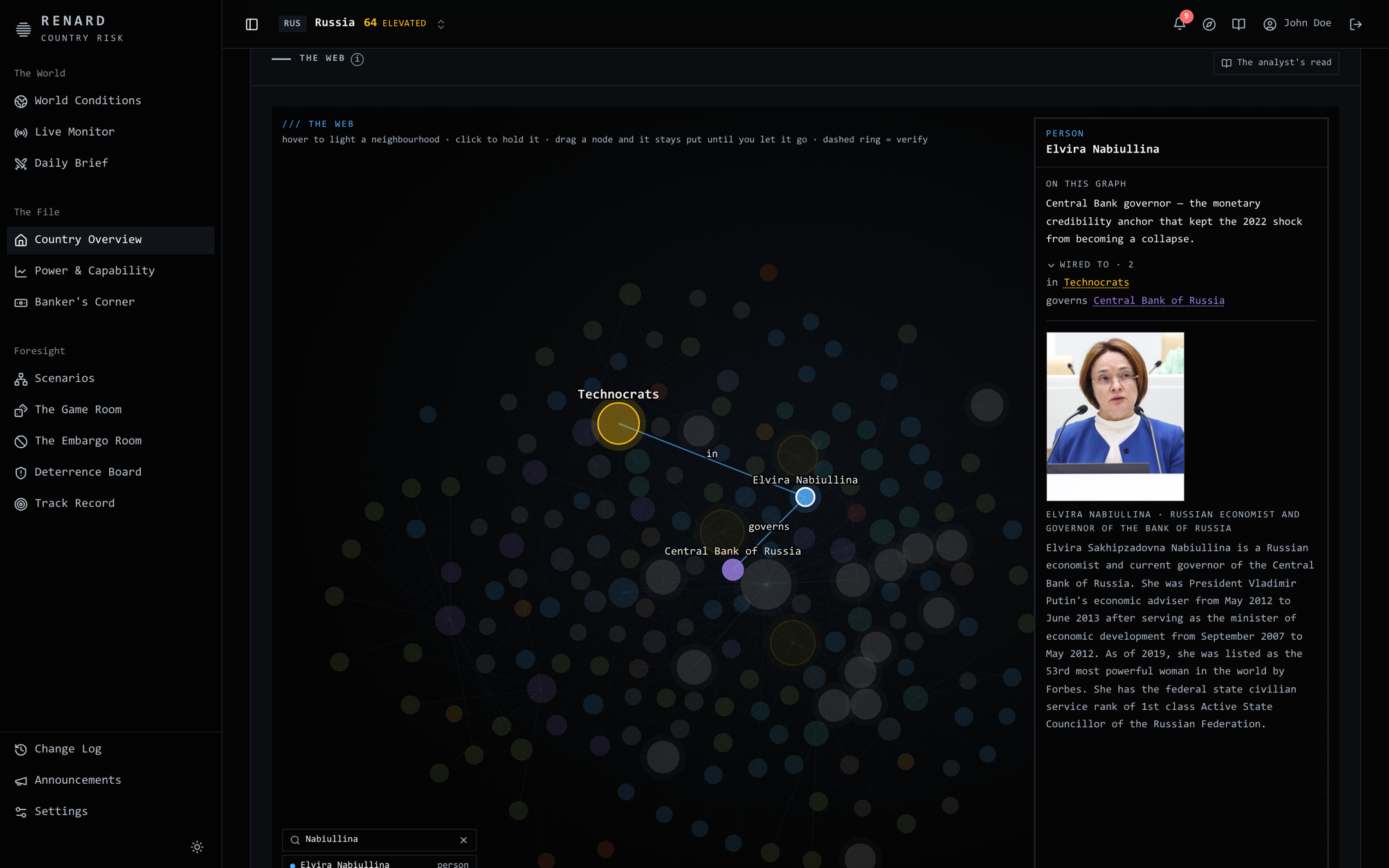
The dossier's web in Renard: people, institutions, enterprises and locations on one graph, with the informal wiring curated by an analyst.

The dossier’s web: everything the file names, on one graph.

Capability

What a state can actually do

Power & Capability ranks forces, equipment and arms transfers, and draws the chain of command. Capability is read as what is held and who commands it, not a headline budget.
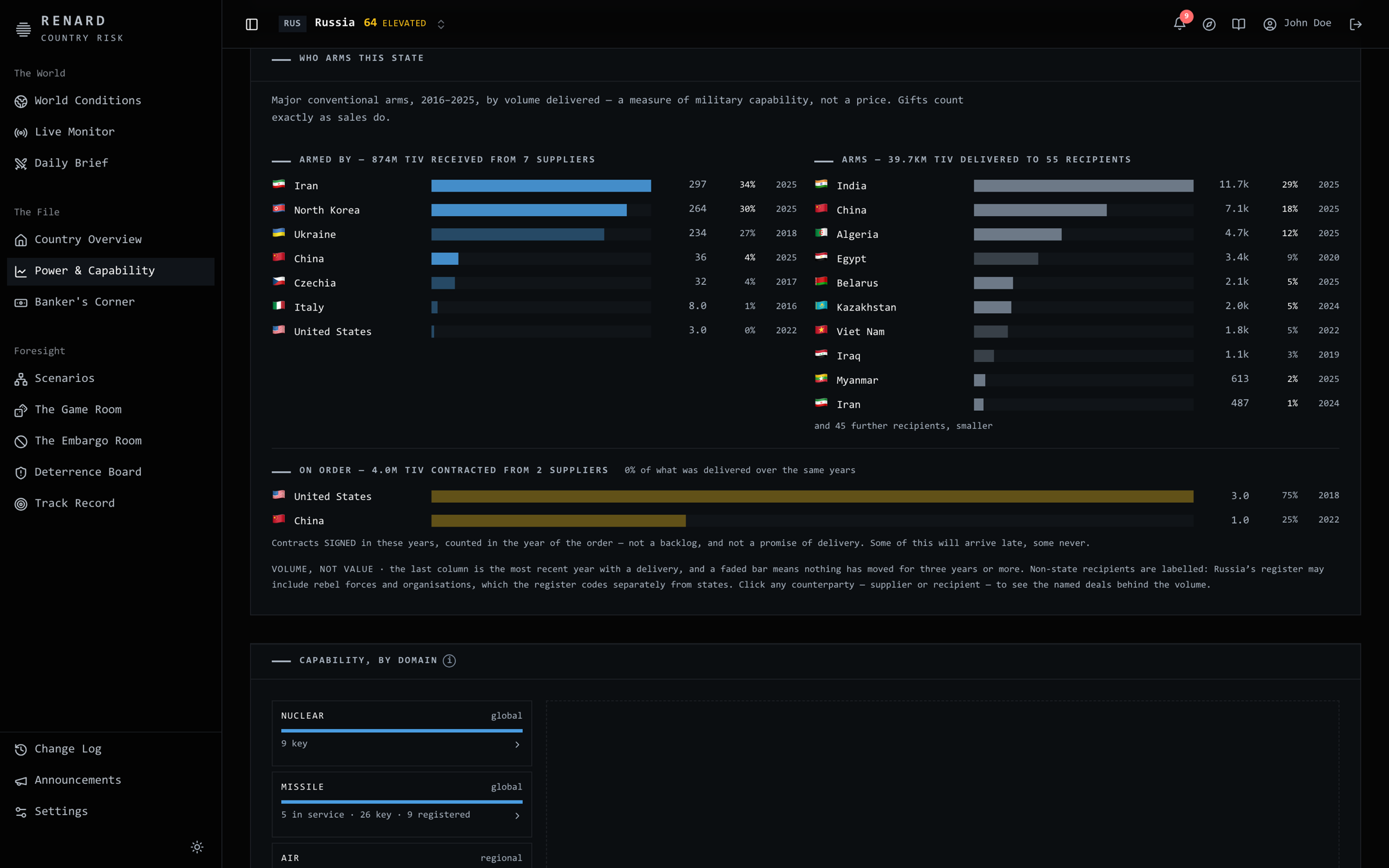
Power and Capability in Renard, showing force and equipment rankings and the chain of command.

Power & Capability: forces, equipment, transfers, command.

The money

What money costs, and what it earns

Banker’s Corner is the lender’s chair: policy rates, the currency, paper outstanding and the trade book, the questions a credit committee asks about a sovereign.
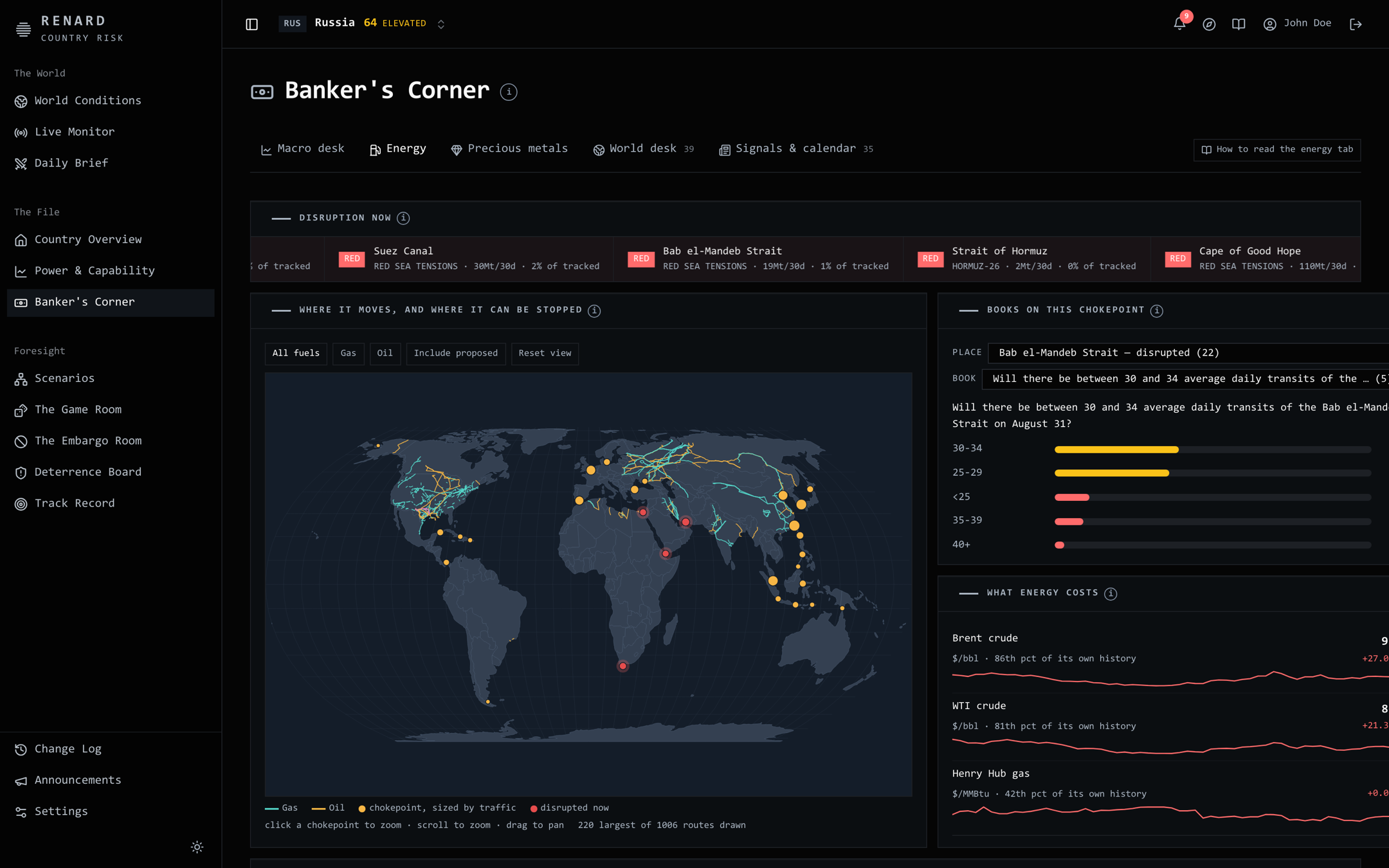
Banker's Corner in Renard, showing policy rates, currency, paper outstanding and trade.

Banker’s Corner: the sovereign from the lender’s chair.

The watch

What happened in the last hour

The Live Monitor carries conflict, unrest and news as it lands, and the Daily Brief is the morning read on top. Alerts fire on the countries you are watching.

Live Monitor: a country acquired, its signals on the tape, a channel on the air.

Foresight

Scenarios, and a record of being wrong

Scenarios are structured rather than narrated, the Deterrence Board and Embargo Room test what would break, and the Track Record scores every forecast once the answer is known.
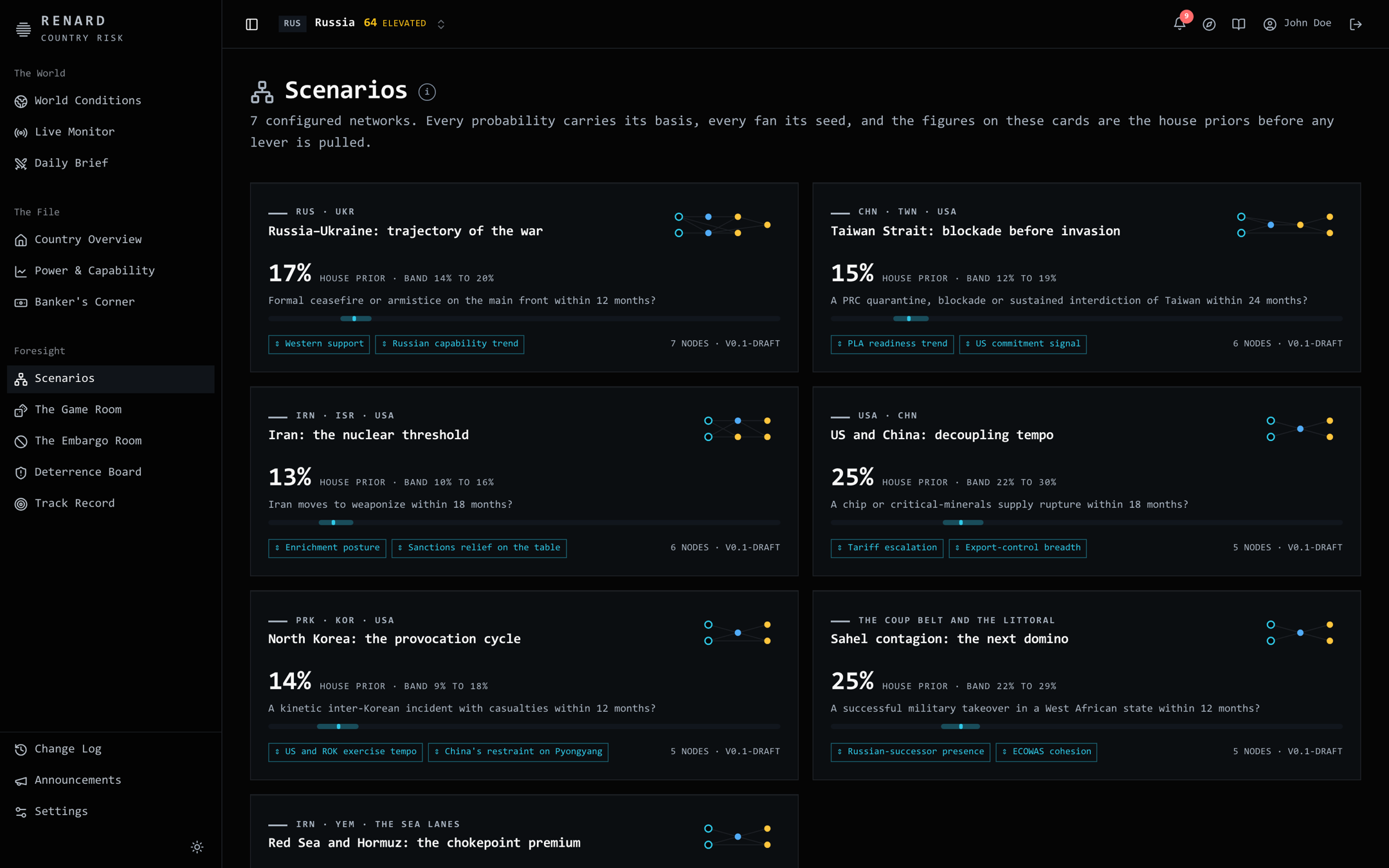
Scenario analysis in Renard alongside the Track Record of scored forecasts.

Scenarios and Track Record: structured, then graded.

Before you rely on it

It is a screening tool

A score narrows where to look and states why it moved. It is not a rating, and it does not tell you what to do with a position.

Judgment is labelled, never hidden

Some pillars compute from indicators alone; others carry an analyst overlay. Which is which is stated on the country file, because a judgment presented as arithmetic is the failure mode here.

Public sources only

World Bank, IMF, SIPRI, the sanctions registers, IMF PortWatch and open reporting. No proprietary intelligence, and nothing on the page that cannot be cited.

Try it on a real country

Preview Renard, live on three files.

Pick a country and the product opens as a guest: the world desk, the dossier and the globe, on real scores through the real pipeline. The deeper layers are visible behind the gate.

Request a country →

Scores are computed by the engine from World Bank, IMF and news-flow data with the analyst overlay on top, and refresh with the product. For information only. Not investment advice.

Status

Renard is in beta and sold separately from Lynx, provisioned per organisation. One sign-in covers both products.

Goes straight to the operator. We reply to every request, including the ones we turn down.