The bank that did not fail from a run
Tioga-Franklin filed a Call Report seven weeks before the FDIC closed it. Read on that filing alone, its liquidity was the strongest thing about it, which is the part worth sitting with.
On 21 August 2026 the FDIC closed Tioga-Franklin Savings Bank of Philadelphia and sold its deposits to Second Federal Savings and Loan Association of Philadelphia. The bank held $68.4 million in assets and had been open since 31 March 1873.
Seven weeks earlier it filed a Call Report. Everything below comes from that filing and the twelve before it. No inside information, no supervisory correspondence, and nothing that was not public at the time.
What the last filing said
Running the 30 June 2026 filing through our CAMELS-style scorecard returns an indicative composite of 4, the band the supervisory framework describes as serious financial or managerial deficiencies.
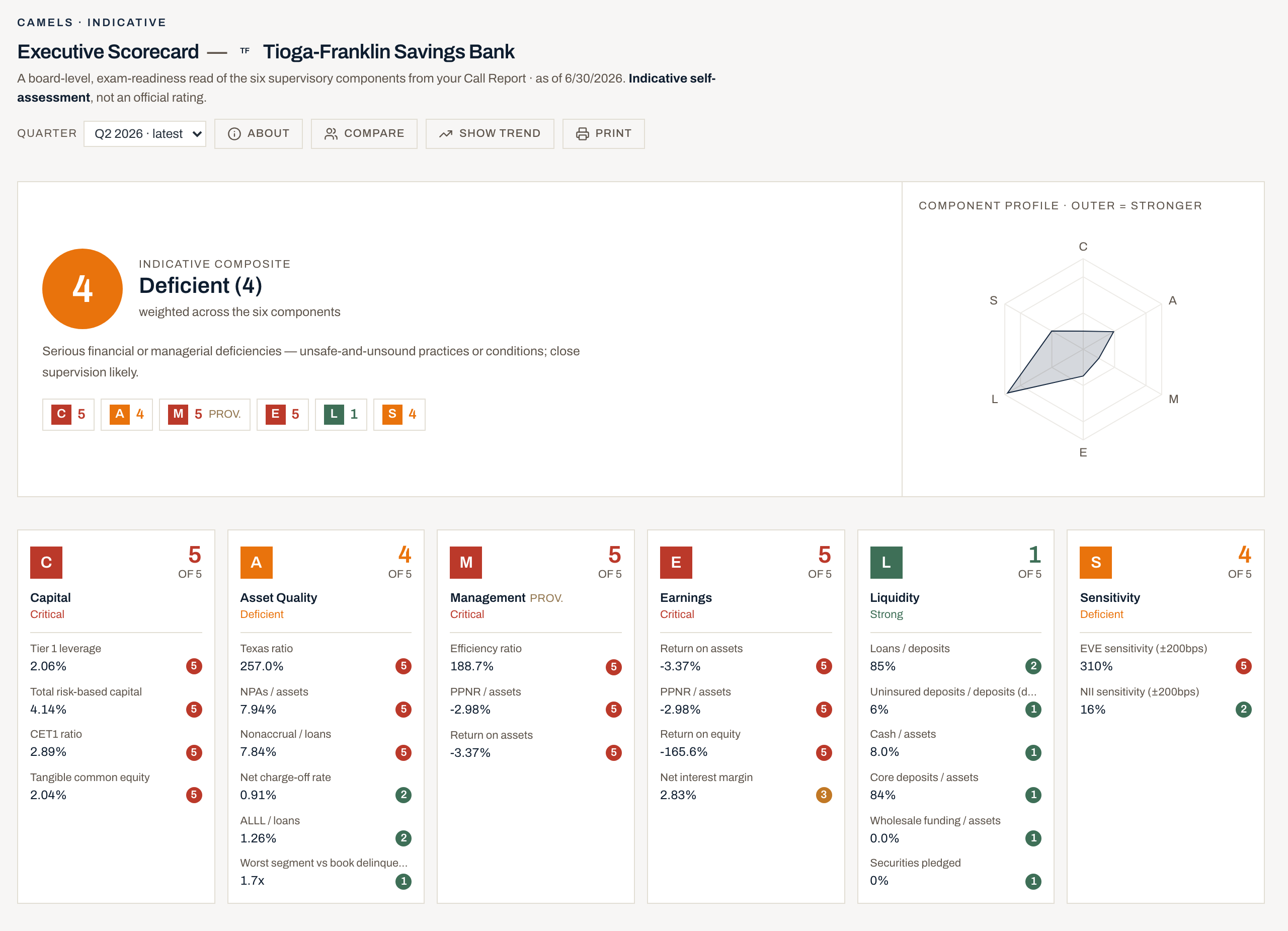
Five of the six components are scored 4 or 5. Capital, management and earnings are all at 5, the critical band. Asset quality and sensitivity sit at 4.
The capital figures are the ones that end an institution. Tier 1 leverage of 2.06%, against a 14.15% average for the 374 banks in the same asset tier. Total risk-based capital of 4.14%, which is below the 8% adequately capitalised threshold and inside the range prompt corrective action is built for. Tangible common equity of 2.04%.
The asset quality figures explain where the capital went. A Texas ratio of 257%, meaning problem assets are more than two and a half times the capital and reserves available to absorb them. Nonaccrual loans at 7.84% of the book, against a 1.24% peer average.
The earnings figures explain why none of it recovered. Return on assets of -3.37% where the peer group earned 0.99%. Return on equity of -165.6%. An efficiency ratio of 188.7%, which means the bank spent $1.89 for every dollar of revenue it produced.
The component that was fine
Liquidity scored 1. Strong. The best score the scale has.
That is not a modelling error, and it is the most useful thing in the file. Loans to deposits at 85%. Uninsured deposits at 6% of the deposit base. Core deposits at 84%. Wholesale funding at 0% of assets. Cash at 8%.
A bank funded that way cannot have the kind of failure the last three years taught everyone to look for. There was no flight-prone money to flee, no brokered book repricing away, no wholesale lender declining to roll. Ninety-four per cent of the deposits were insured, and insured deposits do not run, because there is nothing to run from.
So the depositors stayed. Between the first quarter of 2023 and the first quarter of 2026, while the bank was losing money every single quarter, deposits grew from $52.8 million to $66.0 million.
Recomputing our scorecard on each of the previous eight filings makes the point better than any single quarter can.
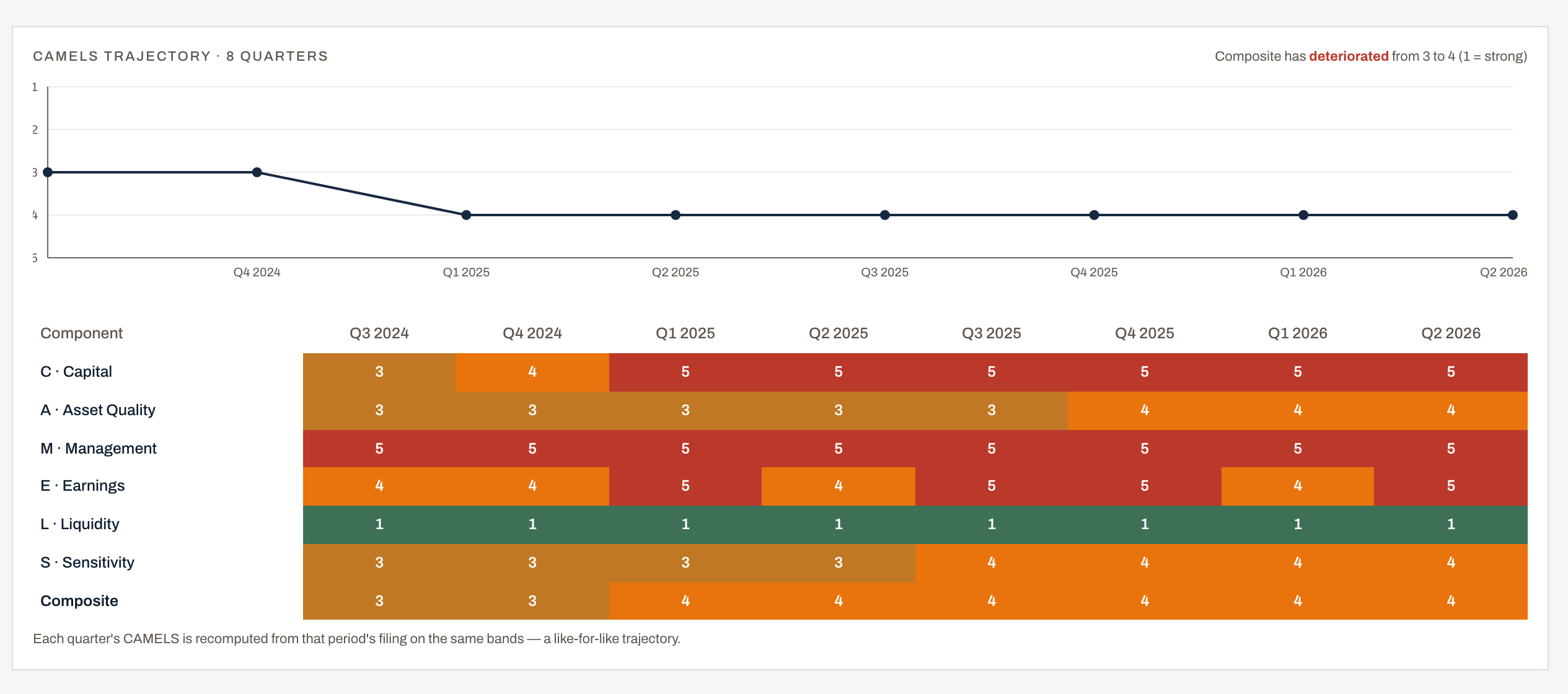
Capital moves from 3 to 5 and stays there. Asset quality goes from 3 to 4. The composite reaches 4 in the first quarter of 2025 and never leaves it, which is six consecutive quarters in the band supervisors reserve for serious deficiencies.
Liquidity is a 1 in every one of the eight quarters, including the last one.
The slope
The failure was legible for eleven quarters. It arrives in one identifiable place.
In the second quarter of 2023 the bank reported no nonaccrual loans at all. In the third quarter it reported nonaccrual at 4.0% of the loan book and posted its first loss. Both lines move from that point and neither comes back.
The allowance is the quieter half of the same story. When the nonaccrual loans first appeared, the allowance covered 47% of them. By the first quarter of 2026 it covered 25%, not because the allowance shrank a great deal, but because the problem assets kept growing underneath it. A bank that is not reserving into a deteriorating book is funding the difference out of capital, and equity fell from $6.7 million to $2.4 million across the same window.
What this is evidence for, and what it is not
The useful claim here is narrow and worth stating precisely: the condition was public, quarterly, and unambiguous for two and a half years. Anyone reading the filings would have seen a bank with critical capital, a Texas ratio above 250%, and losses in every quarter since mid-2023.
The claim it is not evidence for is that the failure was predictable in timing. Nothing in a Call Report says when a supervisor will act. The bank may have been under a formal agreement for years; those are public, and this piece has not read them. Public filings describe condition. They do not describe the response to it, and the gap between the two is where the actual date of closure lives.
There is a second limit worth naming. An indicative scorecard built from reported ratios is not a supervisory rating. Examiners assign those with qualitative judgment and confidential information, and a bank rated by a person may sit a band away from one scored by a formula in either direction.
The part that generalises
Most contingency planning built since March 2023 asks a single question: what happens if the deposits leave. It is a good question and this bank answers it with a shrug. Its funding was granular, insured and local, and by every liquidity measure available it was the healthiest small bank in its peer group.
It failed anyway, from credit, slowly, in the open.
That is the argument for reading an institution across all six components rather than the one that failed most memorably last. A liquidity screen would have cleared Tioga-Franklin every quarter until the day it closed. The capital and asset quality lines were screaming from the third quarter of 2023.
Sources
- BankFind institution directory, cert 33802 · Federal Deposit Insurance Corporation
- Consolidated Reports of Condition and Income, RSSD 885579, 30 June 2026 · FFIEC Central Data Repository
← Back to all insights